Georgia is a cradle of hospitality! Combination of sea and mountains, tasty food and rich history – that’s why tourists like to visit this country soooo much! I spent in Georgia 6 months in 2022 and have lots of insights to share about recycling in this gorgeous country – keep reading.
📌 General information
According to 2021 The World Bank report Georgia has achieved significant progress towards an integrated solid waste management system during the last 5-7 years. At the same time, experts say that there are still lots of challenges to effective waste management goals. I can only agree here.
There is no official recycling rate statistic in Georgia or at least I did not find it (please share it on my Instagram page with me, if you know). As per my assumptions, it should be between 20-30% based on officially published plans to increase the recycling rate for paper, glass and plastic up to 50% and for metal to 80% by 2025.
(hopefully, this section will not be useful) Penalties for environmental pollution in Georgia are divided by different waste types and conditions and how it was thrown: if waste was thrown from houses (up to 2 kg) penalty can be ~60$, if thrown from car ~77$. Penalty for throwing car tires (up to 5 pieces) is ~155$, if 5 pieces and more – up to ~620$. Penalty for environmental pollution with batteries and similar dangerous waste types (weight up to 2 kg) ~155$ (acc. to Waste Management Code of Georgia).
🏭Recycling Centre
Under the “recycling centre” umbrella I can name 3 bright initiatives, but all are available only if you stay in Tbilisi.
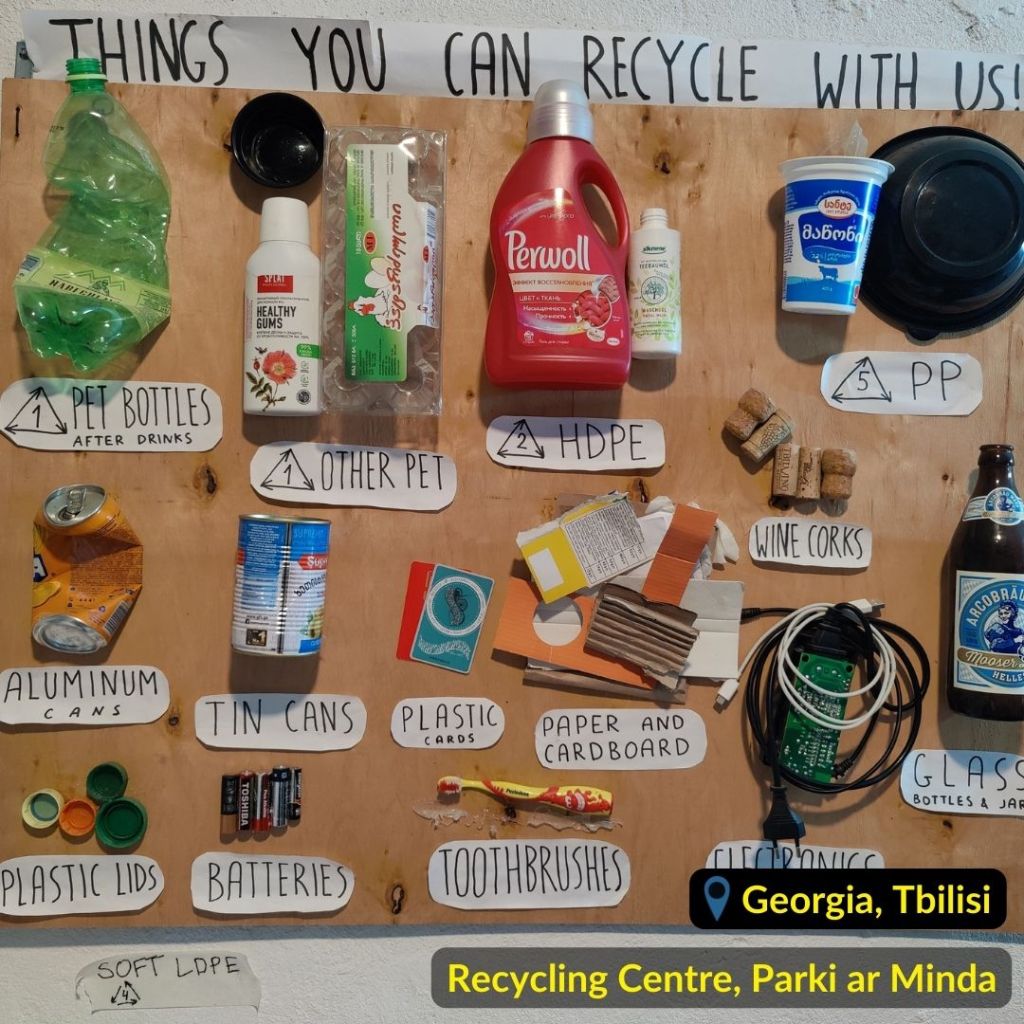
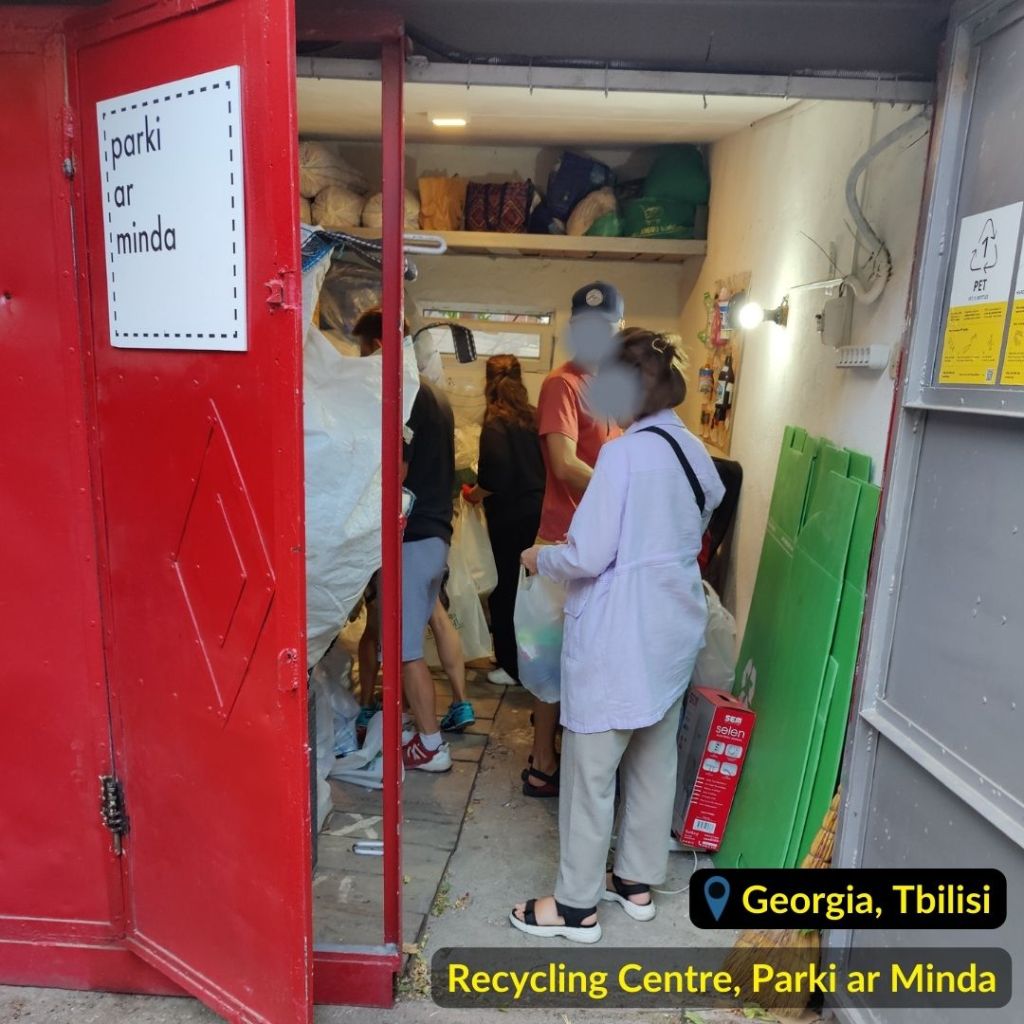
“Parki ar minda” Project is the biggest recycling initiative in Georgia. Around 16 types of waste are accepted (including rare types).
The first option (lazy one) is the EcoTaxi service How it works: you fill in the online form and mention the time and date when it’s more appropriate for you to order Eco-taxi. Then all your waste prepared for recycling is collected by the Team for further final sorting and transferring to the appropriate recycling providers (plants).
The second option (active and free of charge) it’s to bring all your recyclables to one of two Garages – this is the dedicated place that is used as a recycling station. Garages are located in 2 popular areas: one in VAKE and one in SABURTALO. Valid working schedule you can check on Project Social Media pages (information is available both in English and Georgian languages).
The third option is to support zero-waste shop “Zerro Effect” (the only one zero-waste shop in Georgia) and bring your recyclables there. It’s located in the city center and accepts popular recyclables types, such as Plastic (PET-1, HDPE2, PP5), paper, aluminum, cans, and batteries.
Rare waste types accepted in Georgia:
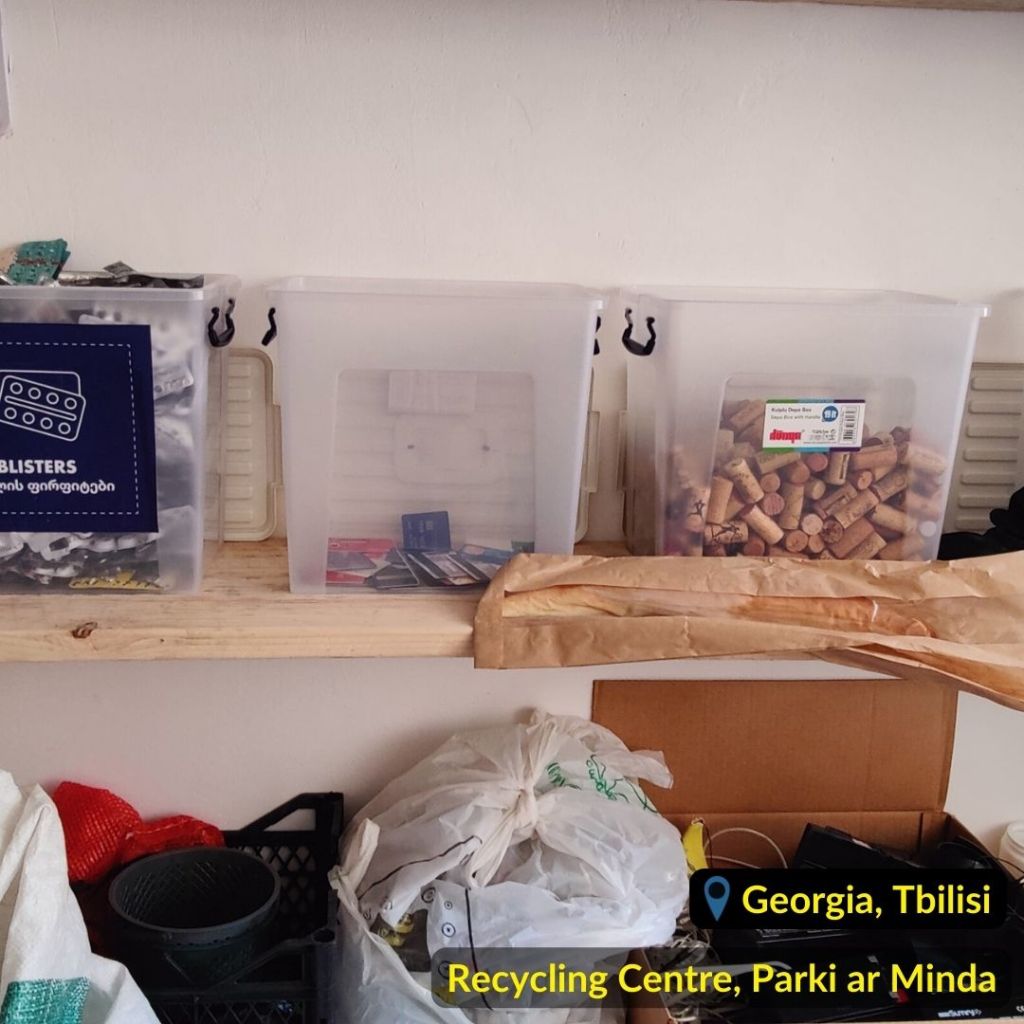
- blisters from medicines, toothbrushes, and plastic cards – accepted by “Parki ar minda” Project for recycling;
- CD disks, vinyl records, colored cables, wires, broken dishes, and ceramics – accepted by “Zerro Effect” shop for upcycling projects (I’m writing this in March 2023, so before your visit to the shop with rare recyclables better to check if this program still valid).


🥛 Glass
📚 Paper
🥤 Plastic
🧷 Metal
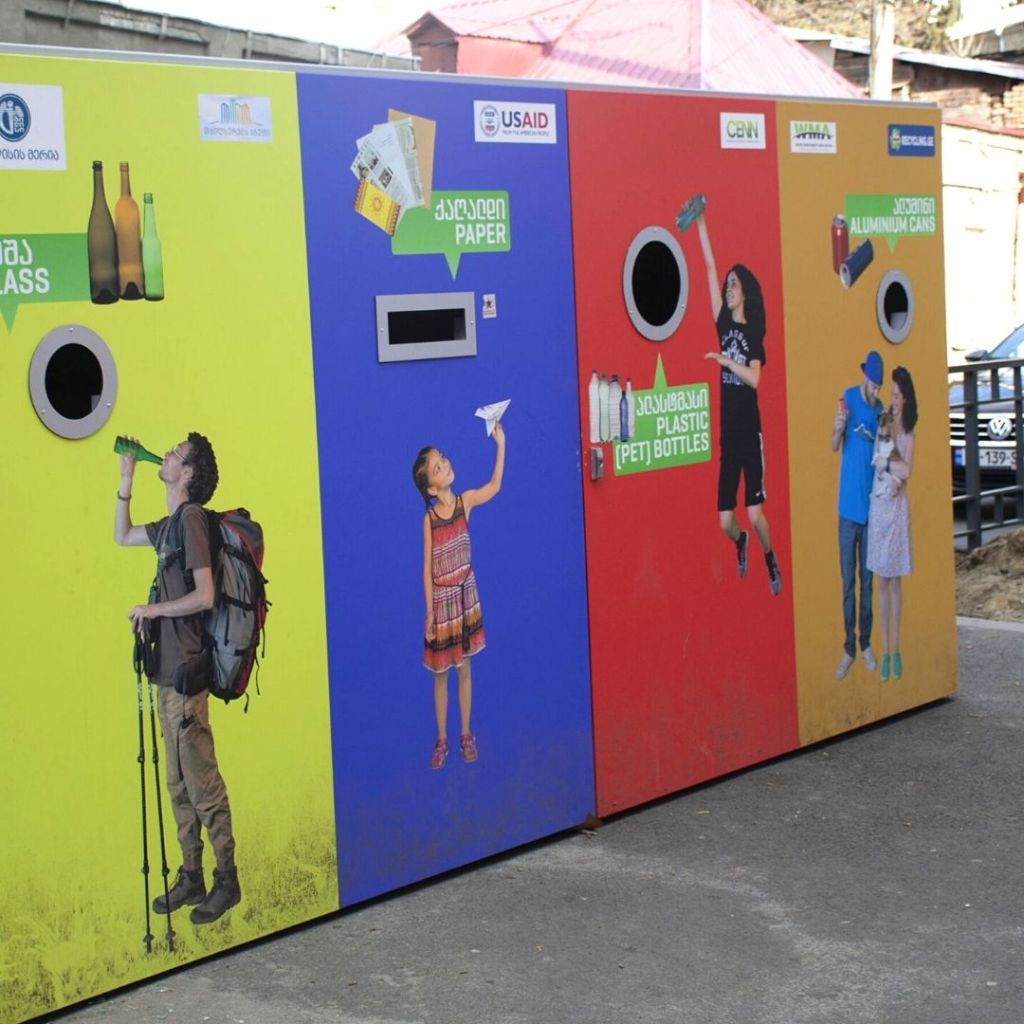
Colorful recycling bins with unforgettable design are installed on the streets of Tbilisi and Batumi (see photos in gallery) to collect the most popular types of waste: plastic, paper, metal, and glass. To find the nearest collection point (bin) please use the recycling map developed by “Parki ar minda” Project.
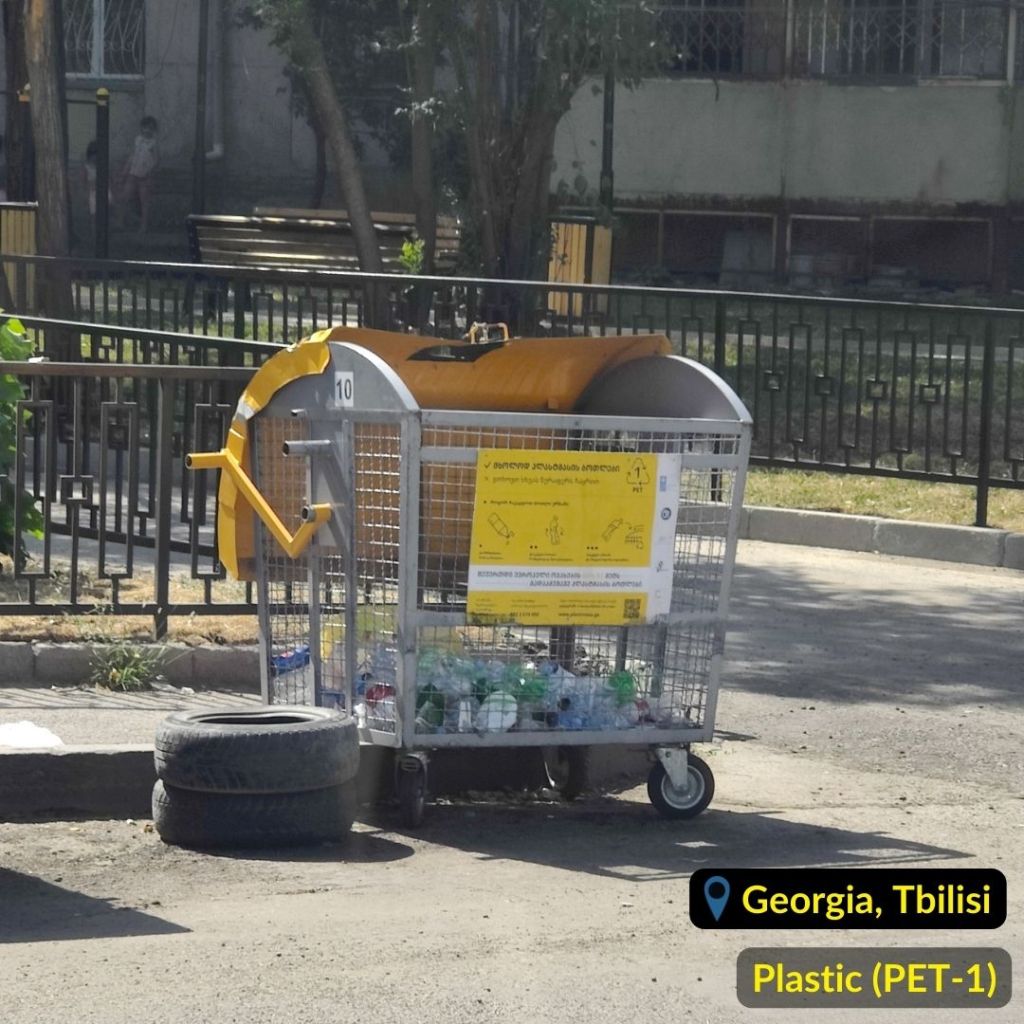
Speaking about plastic waste worth to mention that for PET-1 bottles separate yellow containers are installed in Tbilisi – as it’s one of the most popular waste types. Find the nearest container using the map: the yellow recycling sign. Find an example of the bin in the photo in the gallery.
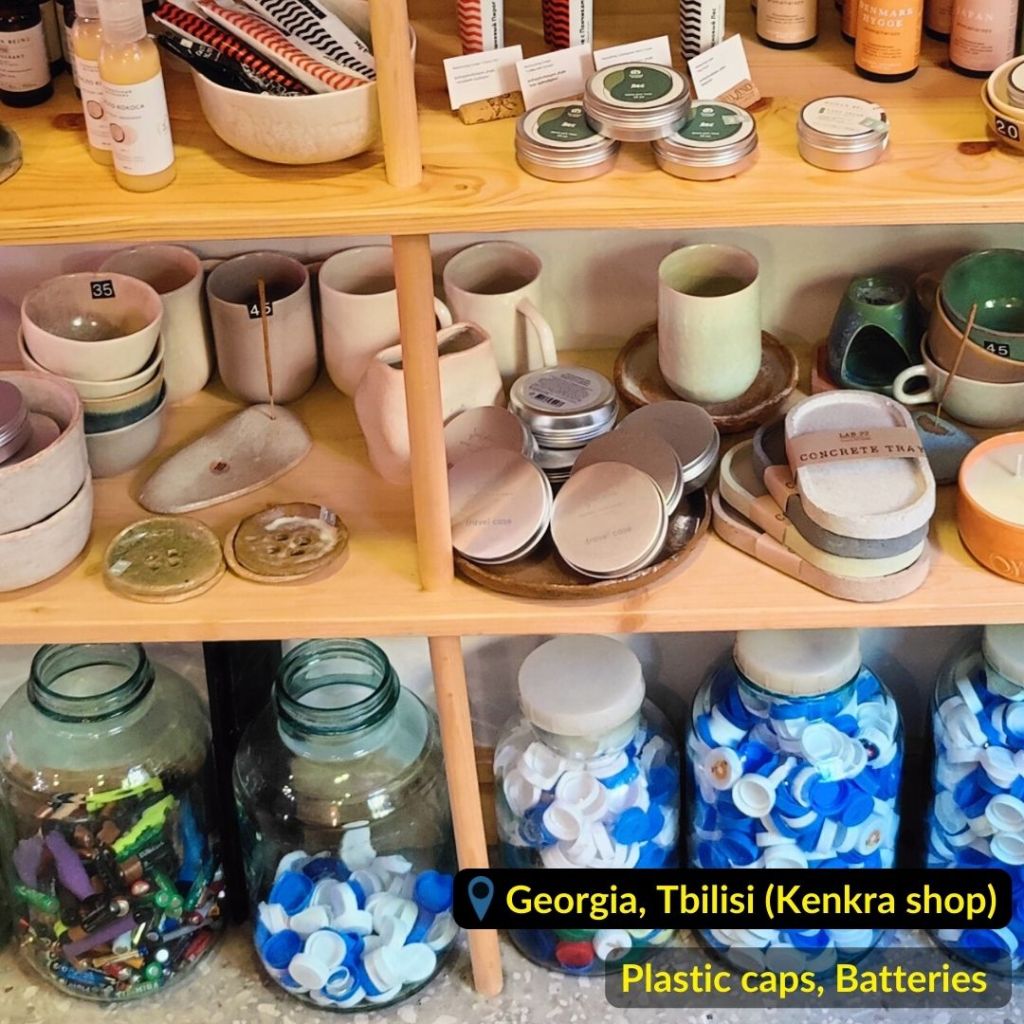
Plastic caps are collected in Tbilisi by the “Kenkra” shop (find the photo in the gallery) and then are sent to the “Recycleaf” Project for recycling.
If you are in Batumi you can bring your caps directly to “Recycleaf” project office (located in the old Batumi city center).
🔋 Batteries
💻 E-waste
Old batteries and E-waste collection points can be found on the recycling map created by “Parki ar minda” Project (batteries and well as e-waste collection points are marked with a blue recycling sign on the map).
🧦 Textiles
Textile is accepted by Caritas charity Project (applicable for Tbilisi only). Please read more details about the Project and also about what is happening with clothes that you put on “Kindness Box” here.
The nearest collection point of “Kindness Box” you can find on the recycling map created by “Parki ar minda” Project (the textile bin is marked as a red “hanger” on the map).
Another option is to bring and leave your clothes at Habada Store – Circular fashion space (the same building as Zerro Effect Shop).
🍏 Organic
Several industrial composting initiatives in Georgia, such as the municipality composting plant in Marneuli, support businesses (for example, agro-markets) with biowaste collection.
At the same time, home composting and mulching are negligible due to low public awareness, poor knowledge and skills, and no incentive to produce compost by citizens. So I can conclude that organic composting initiatives are not available for citizens and for tourists, unfortunately.
It can be a great business opportunity!
🔥 Non-recyclable
In Tbilisi, a state program is being implemented to install underground waste bins (embedded in asphalt). That helps to prevent the “flying waste” problem that is valid for open-head containers. These trash cans can be used to throw away general waste unsuitable for recycling. But there are still lots of “usual/standard gray” bins, so the ‘flying waste’ problem is still valid here as well.
By Hanna Shahuryna ⭗ Updated on March 2023

 Travel and Recycle
Leave a comment