
Are you ready to roll up your sleeves and transform your kitchen scraps from trash to treasure?
Join me as today we are diving into the magical world of composting.
What is in your waste bin?
Up to 70% of the average consumer’s trash bin is occupied by organic waste. And during the watermelon season, I could imagine that this number can be even up to 90%. And if you also sort recyclables then organic waste can take up to 99% of your bin. Sounds familiar?
But whatever your percentage is – let’s all agree, that organic waste takes the major part of your bin: it’s just a loooot ! And it would be cool to do something about this, right?
Composting – is the best answer to organic waste and today we’re literally digging into this topic and discussing five the most popular and the most effective ways how to compost organics. Let’s discuss them all in a pros and cons way.
Method 1: Worms (interactive)
Let’s start with pros:
✅super fun: children will definitely appreciate the attraction to feed the worms. You can even create your own worm farm.
✅If you want easy-going, hypoallergenic pets, here they are.
✅As an outcome of the worms’ work you will have a very good quality compost. You can use it as fertilizer at home, or in the flowerbed near your apartment. Or even sell it! It’s a really precious material.
✅ There is also a side product of worm composting that you can also sell – it’s a liquid called “compost tea”. But don’t drink it – better use it as a fertilizer for your plants. Just be careful, as it’s a very concentrated liquid – so you should apply it in the right proportion for your plants. Just to give you an idea of how strongly concentrated this liquid is: it can also be used as a pipe cleaning liquid – which is definitely one more advantage of this composting method
Ok, but what about cons?
⚠️Worms eat slower than you can be ready to supply them with your scraps, especially if you have a big family. So, it’s a question mark what to do with the leftovers that can not be consumed by worms.
⚠️ you should be careful with the type of food you feed your worms: it can reveal that they prefer something more sweet, while your, cucumber top will lay in the composter for a long time.
⚠️ Also, be aware, that once you decide to have a worm composter you’re becoming their personal chief: you should cook for them: chopping composting leftovers into very small pieces or even making them smoothie, to facilitate the composting process, as in other cases your it can takes weeks for your worms to consume your scraps.
⚠️To create a proper “home” for your worms you need to buy a special device – a composting bin: it’s not that very expensive, but still. As an idea how to avoid additional costs to your budget you can also consider doing a similar device by yourself.
⚠️As I mentioned, consider worms as your pets, so you should ask someone to take care of them if you plan a long vacation or a business trip. No need to panic, in fact worms do not require any specific treatment, it’s for sure much easier than with cats and dogs, but still – it’s about the care.
⚠️Well, maybe I must start with this point: some people just don’t like the idea that worms would live in their apartments 😳
Method 2: Electric composter (elegant)
Pros:
✅In a couple of hours, so quite quickly, an electronic composter will process several kilograms of organic into a small pile of the fermented dried substrate, which can also be used in the yard/flowerbed or at home for your indoor plants as a fertilizer.
✅I also like that this method is a very simple one: just press the button and that’s it!
Cons:
⚠️ Cost of the devices: prices can vary, but it’s for sure more expensive than the device for worms composting
⚠️Such a composter uses electricity, again, not that much, but still to be taken into account.
⚠️ It’s not often highlighted by the producers of these composters, but I belive it’s important to know before you buy it: electronic composters require to use of special filters, that guess what? Right, you need to change regularly, which in fact means new regular ways to waste money and create non-recyclable waste.
Cost of the device plus electricity plus filters – as a result, it’s the most expensive way to compost.
Method 3: Organic Waste disposer (secretive)
Pros:
✅hides your organic from you in a couple of minutes – super fast!
And here is also a bonus advantage: with this thing, we can save free space in the flat. Compared with all other methods you simply don’t have to store your organic bin.
Cons:
⚠️Actually, it cannot be used everywhere (! and this is super important). YOu literally must check if your city and your particular district have wastewater treatment plants that have a proper infrastructure for collecting biogas. So before you go with this option check waste water treatment facilities rules in your city or even better – in your particular district. In another case, you can make things worse for the planet creating additional sources of methane gases.
⚠️in most of the cases you need to call a plumber for the installation of the waste disposer device.
⚠️This thing is also quite expensive.
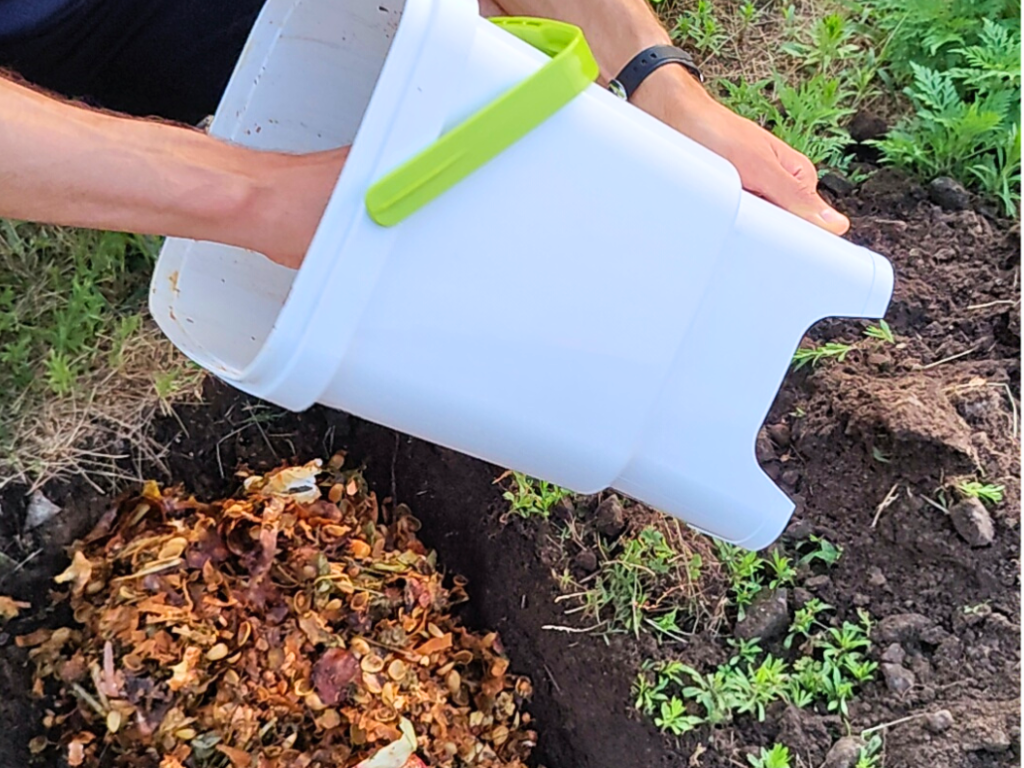
Method 4: Bokashi (detective)
if you’ve never heard the word bokashi earlier – let me give you an idea of what it is. Bokashi – is a composting method that uses bokashi powder. Bokashi powder is usually a mix of rice bran and bacterial cultures teeming with billions of live microbes, ready to ferment and compost your food.
And here I would start with the cons first.
⚠️To use this method you have to buy a special plastic bin and a shovel. Don’t be scared, practically, with a bin: you can reuse any existing bin or container. The key here is to have a very tight-fitting lid. And a shovel can be borrowed from a neighbor.
⚠️Once in a month or two you have to go and bury the organic from your bin. I would say for some people it can sound like a very scary experience, but it’s again easier than it sounds: none expect you will dig a cave, ok?)) – a relatively small hole in the ground would be more than enough. But still it can cause some questions from your neighbors.
⚠️If you’re living in a cold climate it can be challenging to do your digging exercise during the winter.
⚠️This method is welcoming chopping, as well as worm composting method. But comparable to worm composting here there are no specific requirements to make sizes very small. For example, if we take a banana pill cut it into 3-5 pieces so that it takes up less space (and also it would be easier for a banana pill to degrade in the soil.
⚠️Bokashi powder costs money, but it’s a very small amount: 2-3 euros for 1 kilo of bokashi powder will be enough for approximately 1 year of composting.
⚠️Bokashi bin is approximately 10-20 liters on average. So you should plan strategically where you’ll place it.
Pros:
✅ I like that with bokashi composting you have a chance to see the full cycle of your organic waste which helps you to feel that everything is interconnected in Nature and nothing is disappearing magically in nowhere. And the right place for your compost is definitely the soil. Not a landfill. By the way, did you know that approximately 40% of the content in landfills is organic waste?
✅ Not an obvious advantage, but still: I do like the smell of bokashi – for me, it’s similar to bread and beer. No unpleasant smell – I promise! So worth trying!
✅ …and bokashi compost also smells very pleasant – for me, it’s similar to apple vinegar.
✅ Similar to worm composter you have a side product: compost tea. Will not duplicate info – as it’s practically very similar to worm composting liquid.
✅ It’s convenient: you have one dedicated bin for organic that you can refill any time you want.
All previous methods that we discussed are related to home composting but are not limited to this list. But there is also the thing that is called Industrial composting.
Method 5: Industrial composting
It’s a method that is widely used by municipalities in cities around the world.
Pros:
✅ Efficiency: Industrial composting facilities can process large volumes of organic waste efficiently, making it suitable for managing waste generated by businesses, municipalities, and institutions. And Scalability also goes to pros here
✅ I also consider that regulatory compliance can be considered as a big advantage: : industrial composting usually means strict regulations and standards. Which guarantees that the final product is safe for people and the environment.
Cons:
⚠️ Requires infrastructure and high initial investments: Setting up and operating industrial composting facilities requires significant investment in infrastructure, equipment, and operational expertise.
⚠️ Industrial composting due to it’s scale can generate odors and attract pests if not managed properly, leading to potential complaints from nearby residents or businesses.
⚠️ Contamination risk: plastics, metals, and chemicals can accidentally become part of the composting bin which for sure disrupts the composting process and compromise the quality of the final product.
⚠️ Transportation impacts: Transporting organic waste to industrial composting facilities can incur carbon emissions and logistical challenges, especially if the facilities are located far from the waste sources.
I would be glad to know your composting experience: share in the comments! And by the way, guess which composting method is my favorite one?
Let’s compost like there’s no tomorrow and reimagine the way we think about waste!
P.S. By the way, if you prefer the video version – find the link to my YouTube channel and also link to my Podcast Platform.
By Hanna Shahuryna ⭗ Posted on May 2024


 Travel and Recycle
Leave a comment