Circular Economy Alphabet is a place in this blog, where we’re discussing interesting and at the same time confusing words and abbreviations from the sustainability world. And the word of the day is Biodegradable.
By the way, if you prefer the video version – find the link to my YouTube channel and also link to my Podcast Platform.
History of the term “biodegradable”
The term “biodegradable” appeared in scientific literature and environmental discussions since the mid-20th century.
Biodegradable plastics are used widely in the production of packaging materials such as bags, films, and containers. Another popular way to use biodegradable plastic is tableware: plates, cups, and straws. Non-obvious usage examples are the production of clothing, footwear, and even medical devices.
Biodegradable sounds so cool, right? I mean, literally, if we split the word into two: bio and degradable – both parts bring some level of comfort and trust.
But what does it mean, uh?
Nerds find answers in the dictionary
According to Oxford dictionary “biodegradable” means “something that is capable of being decomposed by bacteria or other living organisms and thereby avoiding pollution”.
Sign me up! We all want things to magically disappear in nature once we don’t need them anymore.
Landfill is not a garden
Imagine a world where every product you use simply disappears into the earth, leaving no trace behind. In an ideal world, biodegradable packaging would replace fossil fuel-based plastics, reducing pollution and minimizing our environmental footprint. Sounds too good to be true, right?
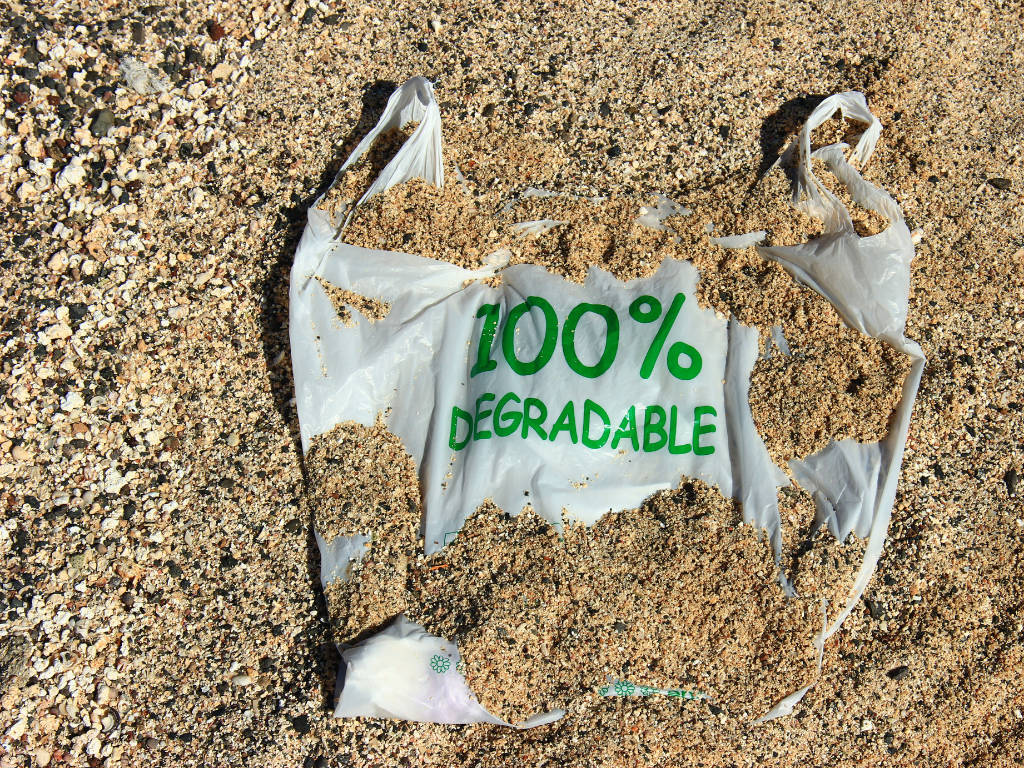
Well, here’s where we need a reality check. Despite their eco-friendly image, many biodegradable plastics are nothing more than a lie. These so-called “biodegradable” plastics often require specific conditions to break down as it’s manifested: such as high temperatures or prolonged exposure to sunlight.
If you buy, for example biodegradable plastic bag and after usage throw it away in an ordinary trash bin, guess what? Right! Nothing! Because, from the trash bin your garbage is going to the landfill. And, surprise-surprise! Landfill is not a garden! At all.
Landfills lack the necessary elements like sunlight and oxygen for biodegradable materials to decompose effectively. So, while biodegradability may sound like the ultimate solution to the waste problem, especially with plastic bags it’s not as straightforward as it seems.
Even in ideal laboratory conditions, biodegradable plastics can not degrade immediately: it’s still a period from several months to several years.
So the word “biodegradable” practically means no more than a marketing trick. Everything can be biodegradable: this plant, that paper, my clothes, and even myself: the key is how many years it would require and what are the conditions.
Call to action!
So next time, during shopping when you’ll see the flashing header “biodegradable” remember: you should not trust this word, it’s just marketing, nothing personal!
It’s important for us as consumers to make our choices consciously with awareness of their impact: read labels carefully, check the certifications and educate ourselves. Like, for example, listening such podcasts.
Hopefully, this episode of Circular Economy Alphabet helped you to understand such a confusing term as “biodegradable” better and you learned something new today: let me know in comments!
By Hanna Shahuryna ⭗ Posted on May 2024



 Travel and Recycle
Leave a comment